
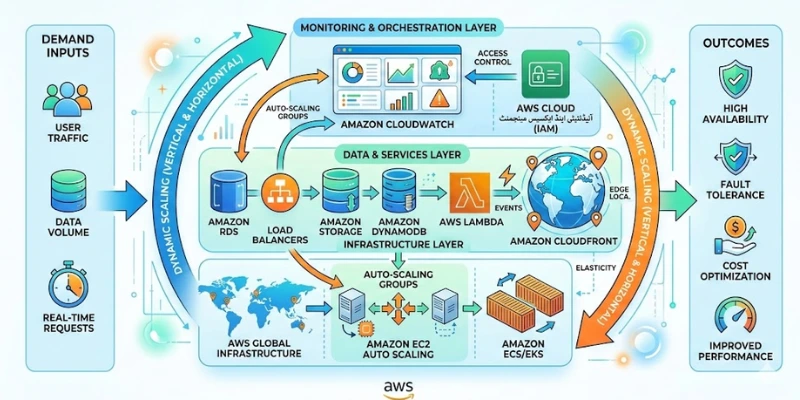
Many developers understand how to build an application, but scaling it for thousands or millions of users feels like a different challenge. Handling sudden traffic spikes, storing growing data, and keeping systems stable require more than basic hosting. This is where cloud platforms step in. Learners exploring AWS Training in Salem often realize that scalability is not just about adding servers, but about designing systems that adjust automatically based on demand. AWS provides the tools and infrastructure that make this possible in real-world projects.
Flexible compute resources
AWS offers services like virtual servers that can be launched or stopped within minutes. Applications do not need to rely on a single machine anymore. When traffic increases, additional instances can be added automatically. When demand drops, resources can scale down to reduce costs. This flexibility allows businesses to handle unpredictable user loads without manual intervention. It also teaches developers to think in terms of elastic infrastructure rather than fixed hardware.
Auto scaling and load balancing
Auto scaling is one of the key features that supports scalable applications. It monitors traffic and adjusts resources automatically. Load balancing distributes incoming requests across multiple servers, preventing overload on a single instance. Together, these services maintain performance and availability. Instead of worrying about server crashes during peak traffic, teams can rely on automated scaling policies to maintain stability and user experience.
Scalable cloud applications are built on flexible infrastructure, automated scaling, managed services, and continuous monitoring. AWS supports this through integrated tools that reduce manual effort and improve reliability. For career growth, understanding these services goes beyond certification; it shapes how applications are designed from the start. Strong cloud fundamentals prepare professionals for roles in architecture, DevOps, and system design. Building deeper expertise through Cloud Computing Courses in Trichy can open pathways into advanced cloud engineering roles where scalability becomes a core responsibility.
Managed database services
Applications often fail to scale because their databases cannot handle increased traffic. AWS provides managed database services that support scaling both vertically and horizontally. Storage can grow without downtime, and read replicas can distribute heavy workloads. These services reduce the need for manual database management. Developers can focus more on application logic while AWS handles infrastructure-level performance adjustments.
Serverless architecture
Serverless computing allows developers to run code without managing servers directly. Functions execute only when triggered, and scaling happens automatically in the background. This model is useful for event-driven applications and microservices. It reduces operational overhead and supports rapid scaling without pre-configuring servers. Many professionals strengthen their understanding of such cloud models during Cloud Computing Courses in Erode, where practical projects show how serverless systems respond to real-time user requests.
Storage and content delivery
Scalable applications require reliable storage and fast content delivery. AWS provides object storage that can handle massive volumes of data. Content delivery networks distribute static content across global locations, reducing latency. This ensures users from different regions experience consistent performance. Scalability here means not just handling more users but serving them efficiently regardless of location.
Monitoring and performance tracking
Scaling is not only about adding resources; it also involves monitoring system behavior. AWS includes monitoring tools that track CPU usage, memory, request rates, and application health. These insights help teams adjust scaling policies and identify performance bottlenecks. Proactive monitoring prevents downtime and improves reliability. It also prepares professionals for roles where performance optimization is part of daily responsibilities.
Regional adoption and career growth
Cloud adoption is expanding beyond major tech hubs. Startups, educational institutions, and enterprises in regional markets are moving their applications to cloud platforms. This creates job opportunities for cloud professionals across different cities. Learners completing AWS Training in Trichy often find that organizations expect practical knowledge of scaling, deployment, and cloud architecture rather than just theoretical understanding.
Also Check: The Most Quintessential Characteristics of AWS and Cloud Services